


Webinar wrap-up’s – Thanks to all our presenters this month
26 October 2026
Share


We have had a busy month hosting several webinars. A huge thank you to all involved.
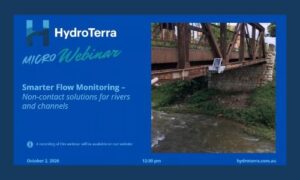
HydroTerra Micro Webinar – Smarter flow monitoring: Non-contact solutions for rivers and streams
Watch Here
We had a great discussion with Troy Thompson and Richard Campbell and investigated the latest developments in non-contact flow measurement technologies. Troy and Richard provided an excellent overview of how advances in radar and LiDAR technology are making flow monitoring safer, more reliable and easier to deploy across a wide range of applications
Key takeaways:
- Surface water flow data is essential for flood management, water resources, environmental monitoring and infrastructure planning.
- Non-contact radar sensors provide safer, lower-maintenance and more reliable monitoring, particularly during high-flow and flood events
- Modern radar technology can continuously measure water level, velocity and flow while supporting remote telemetry and real-time monitoring.
- The latest radar and LiDAR solutions can automatically map channel profiles, reducing fieldwork and improving measurement accuracy.
Selecting the right monitoring location and installation approach is critical to achieving accurate and dependable flow data.
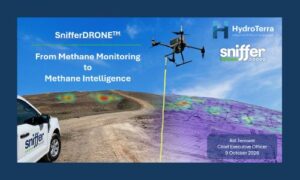
Bill Tennant – From methane monitoring to methane intelligence
Watch Here
While Bill Tennant, CEO of Sniffer Robotics, was visiting from the United States, we took the opportunity to add an extra webinar to our 2026 program. A sincere thank you to Bill for sharing his expertise and practical insights into the future of methane monitoring.
Key takeaways:
- Drone-based methane monitoring enables rapid, repeatable and highly accurate identification of emission hotspots, helping operators focus remediation efforts where they will have the greatest impact.
- The greatest value comes from moving beyond methane detection to methane intelligence, where emissions data is combined with wellfield and operational data to identify root causes and guide corrective actions.
- Detailed GIS visualisation and analytics provide near real-time insights, allowing landfill and biogas operators to prioritise maintenance, optimise gas collection systems and improve regulatory compliance.
- Integrating emissions monitoring with ongoing performance tracking helps verify remediation success, quantify emission reductions and demonstrate continuous improvement over time.
- Effective methane management can deliver both environmental and commercial benefits through reduced emissions, increased gas recovery and improved operational decision-making.
Huade Guan – Using plants as sensors: Rethinking how we monitor water stress

Watch Here
Thank you Huade for challenging us to rethink how water stress is monitored. By treating plants as living sensors, Huade highlighted new opportunities to detect stress earlier, understand root-zone water storage and strengthen water-resource forecasting.
Key takeaways
- Plants can reveal water stress before the signs become visually obvious.
- Continuous sap-flow and water-potential monitoring provides a window into root-zone water availability.
- Canopy temperature offers a practical indicator of plant stress across trees, streetscapes and vegetation communities.
- Remote sensing allows plant-based insights to be expanded from individual trees to landscapes and catchments.
- Land-surface temperature data can contribute to low-flow prediction months ahead, supporting more proactive water planning.
All the webinars can be viewed in our webinar library
Visit our Webinar Library