


What a great webinar – Thank you Dana Windle
27 October 2025
Share


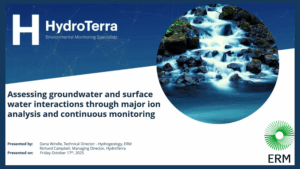 Our sincere thanks to Dana Windle from ERM who presented a fantastic webinar to our community. Dana’s depth of knowledge is outstanding; here are a few takeaways from her presentation.
1. Groundwater and surface water behave differently
- Surface water responds quickly to rainfall and is easier to observe but can be ephemeral and challenging to access safely during high flows.
- Groundwater responds more slowly and is harder to monitor, yet its variability strongly influences flow directions and interactions with surface water.
2. Seasonal cycles drive interaction dynamics
- Start of the wet season: “First flush” events often see surface water dominating; water quality can be poor (high turbidity, acidity, metals).
- Mid–late wet season: Increased flows dilute contaminants; groundwater levels rise, increasing baseflow to rivers.
- Dry season: Surface water may recede to isolated or groundwater-fed pools; groundwater levels fall, sometimes exposing acid sulfate sediments.
3. Monitoring requires careful timing and design
- Capturing transitions between wet and dry seasons—or tidal cycles in coastal zones—is essential for understanding system dynamics.
- Accessibility and safety challenges highlight the importance of planning and durable instrumentation.
4. Continuous monitoring enhances understanding
- Dataloggers and telemetry enable high-resolution, real-time data that can reveal short-term variability and improve conceptual models when integrated with manual sampling.
5. Major ion chemistry helps trace water sources and mixing
- Major ions provide insight into groundwater and surface water mixing processes.
- Tools like Piper, Schoeller, and Durov plots help visualise geochemical relationships and identify flow paths and contaminant movement.
6. Robust conceptual models are essential
- Integrating hydrogeochemical data, hydraulic gradients, and monitoring results supports accurate site conceptualisation.
- Improved understanding informs better monitoring strategies, management decisions, and targeted investigations
If you weren’t able to tune-in you can rewatch it from our Webinar Library.