


Beacon Passive Gas Soil Samplers
29 May 2025
Share


Beacon Environmental – Case Study: New Elementary School Construction on redeveloped Brownfields Site
Beacon Passive Soil Gas Samplers are proving to be an excellent technology for soil gas surveys. They are an extremely sensitive technology for detecting VOC’s in soil and are easy to deploy and analyse. HydroTerra assist to make a Beacon soil gas sampling project as simple as possible. Let us know how many samplers you require and when. We arrange the shipping of the samplers to you, the return of the samplers to Beacon and then send the final reports to you. During this complete process, correct chain of custody is always maintained. Furthermore, HydroTerra, through our Field Services Team, can assist you with the installation of the samplers and has extensive experience in many such projects.
Here is an interesting case study from the US where the sensitivity of the PSG samplers is demonstrated.
New Elementary School Construction On Redeveloped Brownfields Site
This site was a former dry cleaner from the 1930s to the 1970s. By the early 1990s, all dry-cleaning operations had been removed. An asphalt parking lot was left in its place. Soil and groundwater investigations determined tetrachloroethene (PCE) and breakdown products, as well as petroleum hydrocarbons, were present. From 1999 to 2001 over 1.8 million cubic feet of contaminated soil were excavated and hauled away. Limestone fill was used to geotechnically improve the future building’s footprint. A new elementary school building was then constructed on the site.
Objective
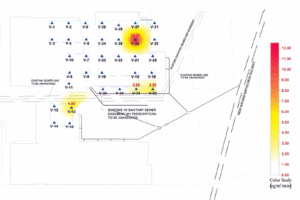
Seven Summa canisters and 35 Beacon surface flux chamber samples were collected over a five-day period. Seven chemicals of concern (COCs) were investigated: tetrachloroethene, trichloroethene, cis-1,2-dichloroethene, trans-1,2-dichloroethene, 1,2-dichloroethane, 1,1-dichloroethene, and vinyl chloride.
Findings
The Beacon samplers defined the vapor intrusion of tetrachloroethene and 1,1-dichloroethene, while the Summa canisters (EPA Method TO-15) reported all non-detects. The Beacon survey enabled the detection of some chemicals at levels below the Summa canister’s practical quantitation limits providing a more complete and realistic vapor intrusion exposure pathway evaluation. Based on the defined vapor intrusion and the sensitivity of the receptors on this site, an on-going monitoring program has been implemented, as well as the installation of a remediation system to mitigate any vapor intrusion.
Reference: Beacon Environmental