


PyroScience’s High-Tech Oxygen Monitoring Powers Barramundi Research
24 November 2025
Share


Elevated temperatures and low aquatic oxygen levels are affected by climate warming and can negatively impact the production and welfare of farmed fish. Both environmental factors and diet affect fish energetics, however, little is known about the dietary effects on fish energetics at elevated temperatures and low aquatic oxygen levels and how that influences growth.

FireSting FSO2-C4 – four-channel Fibre-optic oxygen meter
In order to study how juvenile barramundi respond to high temperatures and low oxygen, researchers at University of Queensland used advanced PyroScience fibre-optic sensors paired with the Firesting four-channel Fibre-optic oxygen meter (FireSting FSO2-C4) and interfaced it with PyroScience Workbench software. This combination provided real-time, high-accuracy measurements of dissolved oxygen during feeding trials and metabolic tests.
By precisely controlling the oxygen levels and tracking consumption rates, the research team could assess routine, post-feeding, and maximum metabolic performance under normoxia and hypoxia, thus providing critical insights for aquaculture in warming environments.
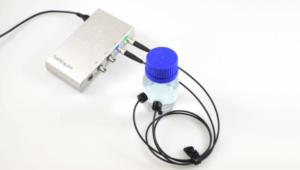
Measuring Oxygen and Temperature with the Firesting O2 C4 and Oxygen Spots
The study found that there was no difference in the maximum metabolic rate and postprandial peak metabolic rate in juvenile barramundi that were fed a high protein or a high lipid diet at chronically elevated temperatures. The findings indicate that neither the high protein, nor the high lipid diet impacted the extent to which aerobic metabolism was constrained by feeding.
It should be noted though, that the high protein diet had a better feed conversion ratio and promoted higher growth and protein deposition.
That could be partially due to an increase in their oxygen-carrying capacity. Consequently, the high protein diet is more suitable for supporting growth in juvenile barramundi at 35 C, and this knowledge provides valuable insight for industry nutritional guidelines.
For further info on these products and others in the PyroScience range, please email our sales staff Email Us
You can read the full paper here – High protein diets improve the growth of juvenile barramundi (Lates calcarifer) at elevated temperatures – ScienceDirect