


When a collaboration of Industry, Government, Researchers and communities works! Thanks to Louisa Rochford And CORRECTION NOTE for past presentation.
27 March 2025
Share


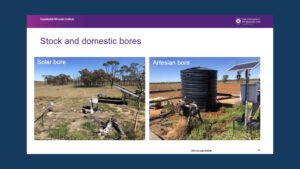 Earlier this month, it was a pleasure to host Louisa Rochford, Senior Research Fellow at the University of Queensland. Her informative webinar showcased a one-of a kind project on improving groundwater management by better understanding consumptive use—showing how collaboration between industry, government, research, and the community can make a real difference.
The webinar took us through the journey of a world-first voluntary bore metering program, bringing together industry, government, The University of Queensland, and the community. The data collected led to a new statistical model that accurately predicts groundwater extraction from these 18,000 unmetered bores, offering a global method for estimating groundwater use in various agricultural and hydrological settings.
An impressive number of questions were asked from participants, highlighting the keen interest and engagement from the audience. Some of the many outtakes from the Louisa’s project were:
- Improved knowledge about groundwater extraction rates from stock and domestic bores on cattle grazing properties
- Learnings on the implementation of voluntary metering programs
- Learnings about the factors driving variation in groundwater extraction for stock and domestic use
- Demonstrates that interview data and metered extraction data for a representative subset of bores can be used to predict extraction at unmetered bores using public domain datasets
For those who missed out on this session or want to revisit the key takeaways please visit our webinar recording on our website.
Link to our webinar page is below.
Visit our Webinar LibraryCORRECTION Note – Past Webinar
HydroTerra would like to clarify a point that was given in Mark Stuckey’s presentation; “An Auditors Perspective – Undertaking Tier 2 assessments under the ASC NEMP Framework”
On slide 10, it was stated that “Exceedances of Tier 1 values doesn’t mean you need to undertake remediation, and it does not mean you need to notify any regulators”. However, please note that notification requirements to regulators vary by state so you need to check with your State Department of Water and Environmental Regulation as to their guidelines.