


Thank you for the insights into Australia’s largest water quality monitoring program
24 November 2025
Share


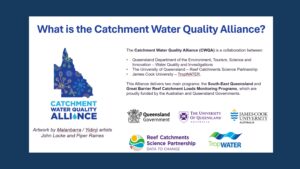 Thank you; Mika Rowston and Richard Gardiner from The University of Queensland, for your presentation that explored principles and applications of the extensive monitoring efforts to safeguard the Great Barrier Reef. We were very fortunate to learn about Australia’s largest discrete and real-time water quality monitoring program.
Some key takeaways from the webinar are outlined below:
Why Monitoring Matters
The Great Barrier Reef Catchment Loads Monitoring Program (GBRCLMP) plays a critical role in:
• Tracking long-term trends in pollutants such as sediment, nutrients, and pesticides.
• Calibrating and validating models to measure progress toward the Reef 2050 Water Quality Improvement Plan.
• Supporting decision-making for reducing land-based runoff into the reef lagoon.
Program Scope and Innovation
• 73 monitoring sites (automated, micro, and manual) across 35 priority catchments.
• Integration of discrete sampling and real-time monitoring for comprehensive coverage.
• Use of Doppler flow measurements and advanced sensors for accurate load calculations.
Key Challenges
• Flooding and access issues during extreme weather events.
• Equipment maintenance in remote, crocodile-prone areas.
• Managing large volumes of data and ensuring quality control through automated and manual processes. [HT_Webinar…hard_Final | PowerPoint]
Benefits of Real-Time Monitoring
• Faster data availability for stakeholders.
• Lower cost per data point compared to lab analysis.
• Enhanced trend analysis and early warning capabilities.
Looking Ahead
The team is developing online dashboards, pesticide risk portals, and real-time river applications to make data more accessible and actionable. These innovations aim to transform raw data into knowledge that drives better environmental outcomes.
A recording of the webinar is available in our webinar library Watch Recording