


Experience our applied online training that bridges theory and fieldwork
27 April 2026
Share


Over the past six months, HydroTerra has been delivering a series of targeted online training sessions to environmental consultants and auditors. Recently they have focused on field techniques for mass flux and mass discharge assessments in surface water. These sessions respond to a growing need across the environmental sector for more robust, defensible data to support contaminant investigation, particularly for complex contaminants such as PFAS.
The one-hour sessions bring together technical expertise from across HydroTerra and industry collaborators, combining practical field knowledge with applied hydrography. Each session is led by three experienced presenters:
- Dr Annette Nolan (Technical Director, HydroTerra),
- Dominic Dillon (Senior Environmental Scientist, HydroTerra)
- Paul Webb (Certified Practising Hydrographer, WaterObs)
The format includes a structured presentation followed by an interactive Q&A, encouraging discussion around real-world challenges faced by practitioners.
The training session begins by establishing the importance of mass flux and mass discharge assessments in surface water investigations. While concentration data remains a cornerstone of water quality monitoring, it often provides only part of the picture. Understanding contaminant loads, i.e. how much mass is actually moving through a system over time, is critical for risk assessment, regulatory compliance, and remediation design and evaluation. This is particularly relevant for PFAS, where episodic flow events can drive significant contaminant transport.
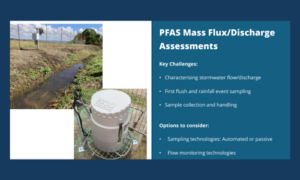 A key focus of the sessions is on automated sampling techniques designed to capture these dynamic conditions. Attendees are introduced to tools such as rising stage samplers, autosamplers and telemetry-enabled systems. These technologies allow for targeted sampling during rainfall and runoff events, capturing critical phases such as first flush and peak flow that are often missed by traditional grab sampling approaches.
The sessions also explore flow monitoring techniques, providing an overview of available methods and their respective strengths and limitations. From Doppler-based systems to stage-based measurements, participants gain insight into selecting appropriate technologies based on site conditions, data requirements and budget constraints.
To support these measurements, the training includes a practical introduction to hydrography and rating curves. This component covers the fundamentals of measuring water velocity and cross-sectional area, and how these parameters are used to develop stage–discharge relationships. Understanding these principles is essential for converting water level data into flow rates, and ultimately into mass discharge estimates.
Feedback from participants has highlighted the value of these sessions in bridging the gap between theory and field application. By combining technical rigour with practical examples, HydroTerra aims to build industry capability and improve the quality of surface water monitoring programs.
As regulatory expectations continue to evolve in relation to emerging contaminants such as PFAS, the ability to accurately quantify contaminant loads will become increasingly important. HydroTerra remains committed to supporting the industry through knowledge sharing and practical training initiatives such as these.
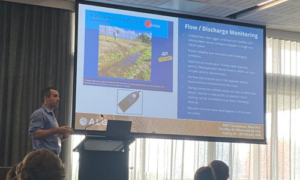
Dom Dillon presenting at the ALGA Mass Flux Symposium 2026
Dominic Dillon also recently presented on this topic at the ALGA Mass Flux Symposium held in Sydney on 25-26 February 2026, which was well received by attendees.
A clear message from the ALGA Symposium was that collecting accurate data for surface water mass flux/mass discharge assessments from rainfall events can provide important metrics for characterising PFAS impacted sites and evaluating remediation success; however, there is a need for guidance and standardisation on undertaking these assessments to ensure more consistency and improved data quality outcomes.
If you would like to arrange a tailored training session on automated sampling techniques, or on any topic that’s relevant to you, please contact us.
Learn more here