


Exploring life four kilometres below the surface
27 October 2025
Share


How does the deep ocean sea floor breathe?
 That’s the question researchers from the University of Southern Denmark set out to answer during their research work in the Clarion-Clipperton Zone of the Pacific Ocean.
At around 4,250 metres below the surface, they carried out the first-ever in situ measurements of how oxygen moves between the seafloor and overlying water in areas rich in polymetallic nodules—those metallic lumps on the abyssal plain that host unique deep-sea life and are increasingly targeted for critical mineral extraction.
A New Way to Measure Sea floor Respiration
The team were able to directly measure benthic oxygen flux—a key indicator of sea floor respiration and carbon cycling—without disturbing the environment. This technique captures the natural movement of oxygen across the sediment-water boundary, offering a more realistic picture of how the deep-sea ecosystem functions.
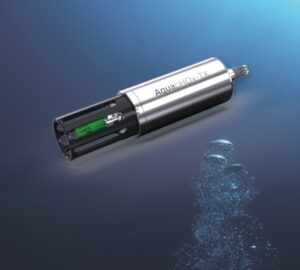
Their experimental setup included PyroScience’s AquapHOx-TX Deep Sea Transmitter with an ultra-high-speed retractable oxygen minisensor, paired with a Nortek acoustic Doppler velocimeter. Despite challenges posed by the crystal-clear water of the Clarion-Clipperton Zone—which complicates acoustic measurements, the system proved robust and produced high-quality, high-frequency oxygen data.
Why It Matters
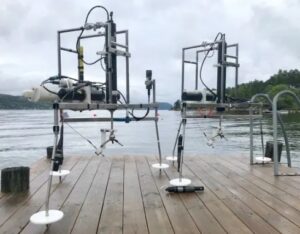
Set-up for Aquatic AEC measurements with AquapHOx transmitter equipped with Ultra-High-Speed Oxygen Minisensors OXR430-UHS-SUB and connected to a Nortek Vector. (Image credit: Karl Attard, University of Southern Denmark)
Understanding how oxygen is exchanged at the seafloor helps scientists gauge the health and productivity of deep-sea habitats. The International Seabed Authority requires benthic oxygen flux measurements to inform environmental impact assessments, and methods like Aquatic Eddy Covariance (AEC) used here are now paving the way for more routine, non-invasive monitoring in the deep ocean.
As efforts continue to refine these techniques, one thing is clear: the deep sea is not as silent or still as it seems—it’s a living, breathing system, and we’re just beginning to understand its rhythms.
Explore the range of products here Explore our products
For further information on these products please submit an enquiry form. Enquire Here