


Hydrasleeve v’s Low-Flow groundwater sampling – A practical comparison
27 October 2025
Share


Groundwater sampling methods should match the site objectives, hydrogeology and analytes of interest. Below is a concise, practical comparison of low-flow (minimal-drawdown) sampling and HydraSleeve (passive, no-purge) sampling to help you choose the right approach for your project.
How they work.
Low-flow sampling: A pump (or bladder/air lift) withdraws water at a controlled, low rate (commonly 0.1–0.5 L/min) near the screened interval. Purging continues until field parameters stabilise, producing a representative sample with minimal disturbance.
HydraSleeve sampling: A collapsible sleeve is lowered empty into the screened interval and then retrieved so groundwater flows into the sleeve via a one-way valve. It captures a grab sample 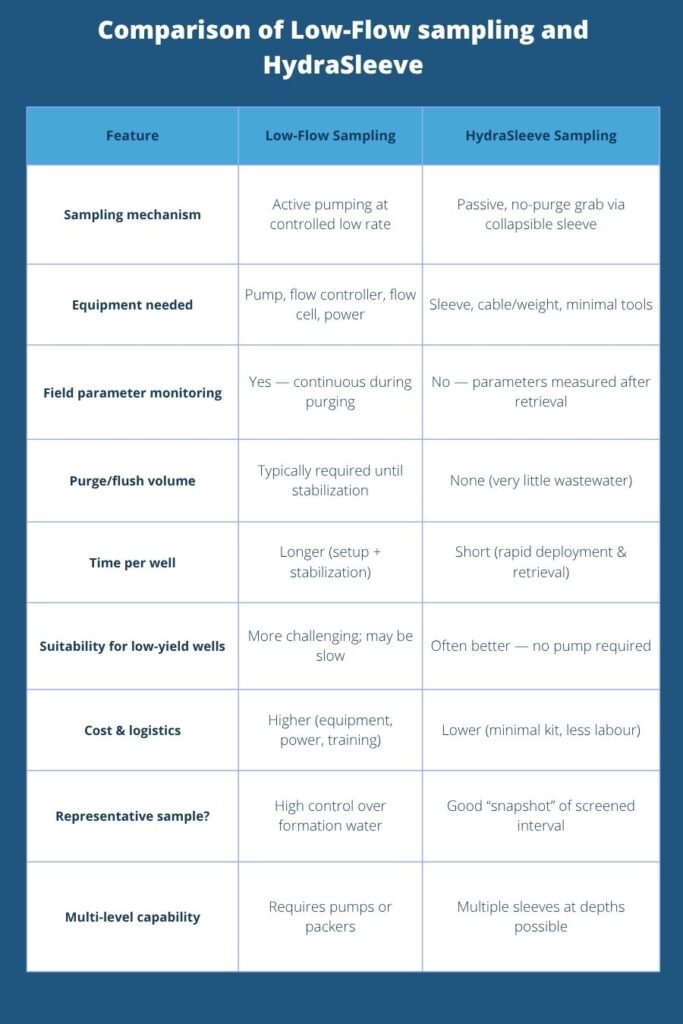 of the water in the screened zone without pumping or generating purge water.
Pros and cons
Low-flow — Positives
• Controlled extraction; allows monitoring until field parameters stabilise.
• Minimises turbidity and aeration for sensitive analytes (metals, gases).
• Widely accepted in regulatory and long-term monitoring programs.
• Flexible for a wide range of analytes and investigative needs.
Low-flow — Limitations
• More equipment, power and trained personnel required.
• Longer field time and purge water to manage.
• Can be impractical at remote or very low-yield sites without generators.
HydraSleeve — Positives
• Simple, rapid, and low-cost deployment; minimal equipment and waste.
• Well suited to remote, shallow or low-yield wells.
• Gives a representative grab of the screened interval with little drawdown.
• Easy to use for multi-level grabs where logistics favour quick sampling.
HydraSleeve — Limitations
• Cannot measure stabilised in-well parameters during sampling.
• Single retrieval gives a snapshot — may miss short-term variability.
• Careful placement or multiple sleeves may be needed in stratified wells.
• Unfiltered whole-water samples can include suspended material affecting some analyses.
Choosing the right method
Both methods produce high-quality, formation-representative samples when used appropriately. Use low-flow when controlled purging and real-time stabilisation data are required, or when regulatory comparability is critical. Use HydraSleeve when logistics, cost, rapid turnaround or very low yields make pumping impractical — or as a pragmatic option for routine or screening rounds. Combining approaches is often sensible for phased investigations.
HydroTerra has been delivering groundwater solutions for over 20 years and can advise on method selection, supply equipment, and support field sampling to meet your project objectives.
Get in touch with us for help with your groundwater sampling Get in touch