


Modern Landfills – Key take-aways from our most recent webinar
29 September 2025
Share


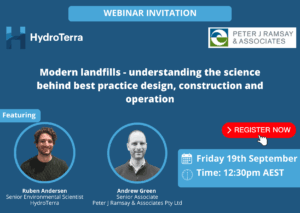
Our recent webinar, “Modern Landfills – Understanding the Science Behind Best Practice Design, Construction and Operation,” presented by Andrew Green and Ruben Andersen, explored how today’s landfill engineering combines science, regulation, and monitoring to protect the environment.
 Andrew explained how engineered liners and capping systems—made from layers of clay, geotextiles, and geomembranes—are designed to meet strict EPA Victoria performance targets. For instance, Type 2 landfills must limit leakage to just 10 litres per hectare per day.
Behind these systems lies a strong scientific foundation. Tools such as Darcy’s Law and hydrologic models are used to predict seepage and infiltration, while design performance depends heavily on rigorous quality assurance and quality control. From manufacturing checks to onsite weld testing and integrity surveys, these measures ensure that construction matches design intent.
The presentation also highlighted that good design is only part of the solution. Long-term monitoring is essential to track leachate, detect leaks, and maintain stability. Vegetation on capping systems, for example, not only prevents erosion but also contributes to the overall resilience of the site.
The key message was clear: when built and managed to best-practice standards, modern landfills are highly effective at reducing environmental risks. But success depends on ongoing vigilance—through robust QA/QC, careful monitoring, and a commitment to sustainability.
If you missed the presentation, you can watch a recording in our Webinar library Our Webinar Library